Neither
Roger Mannon nor any of his team stared at goats or walked through
walls during their training with the U.S. Army’s first experiment
in psychic warfare. Yet his account of their six-day session at the
mountaintop
Monroe
Institute
in Faber, Virginia, is sufficiently bizarre that in order to feel
comfortable reviewing Secret
Warriors, Psychic Spies
I had to do a little research of my own, albeit mostly with Google,
gathering online information about the training site and the only
participant in the experiment besides Mannon not given a fictitious
name:
Major
General Albert Stubblebine.
I was surprised to find many
articles confirming Mannon’s references to the government’s
fascination with the psychic concept, which dropped its Top Secret
cover and went public over a decade later when the CIA revealed what
had evolved into Project Stargate.
Also aiding me in gauging
Mannon’s credibility was my having served in the same Army
intelligence and security outfit as Mannon, albeit some twenty years
before Gen. Stubblebine picked him to join with twenty-three other
GIs from stations around the world to comprise what the Army secretly
called “Center Lane.” Their mission at the Virginia mountain
institute was to learn if they were capable of developing the psychic
ability to gather strategic military intelligence by means of “remote
viewing,” in other words using out-of-body mind travel. This was
something Stubblebine claimed to have experienced personally.
 |
SFC Roger Mannon
|
Non-readers’
first exposure to these experiments came with the fictitious movie
comedy The
Men Who Stare at Goats,
in which the character “Gen. Hopgood” was supposed to represent
Stubblebine. The only scene I recall in the movie suggested by Secret
Warriors, Psychic Spies
is when one of the trainees wigs out and runs naked across a training
field at Fort Bragg shooting a pistol. Mannon reports that one of his
team, a young lieutenant missing from training, was found wandering
nude on the institute grounds “quietly
babbling to himself” and
“playing
with his fingers like they were strange and foreign protrusions that
he did not quite understand...The training staff told us they had
managed to get him under control with little effort. He was not
violent but calm and pliant and lost in his imaginings,” and he was
removed from the project. Mannon said the episode was believed to
have killed the Center Lane project, of which upper command officers
had been skeptical all along, questioning the program’s legality.
Gen. Stubblebine retired shortly afterward.
The
question immediately coming to mind is drugs. The lieutenant’s
“psychotic break” as described resembles the classic LSD trip.
“Just
exactly what drugs were you on? That’s what you’re thinking,”
Mannon says, addressing us, his readers. And
drugs figure prominently in the movie, but Mannon denies with
vehemence the likelihood of any unauthorized use of psychotropic
drugs by anyone in the military intelligence community.
“Using
drugs could get you thrown out. Even rumors of drug use could get you
thrown out. Close association with friends that did drugs could get
you thrown out. More than just thrown out of the unit, it could get
you a court-martial and a dishonorable discharge from the Army.”
He
also doubts they were getting drugs in their food, or being
hypnotized to lose control of their minds. The program’s aim, he
emphasizes, was to train them to control their own minds. Yet, he
leaves the door ajar for dedicated skeptics:
“After
battling your way through this narrative, you could decide I am just
a little crazy. I don’t feel crazy, but I am not sure any insane
person does.”
Does Mannon believe he had
out-of-body experiences? Yes, with confirmation from other members of
the team who’d not only experienced their own but recalled him
entering their isolated chamber during training. He describes the
chambers as extremely comfortable, soundproof, darkened units where
each trainee lay on a bed while pulsing sounds and Monroe’s voice
was piped to them through earphones. The group met together after
each session to compare notes.
Here
he describes one of his experiences:
“I listened to the instructions and experimented with freeing
myself from my body. The low, pleasant voice rumbled from the tape:
‘Think
how nice it would be to float out and away.’ Thinking of floating
away and how it would feel, calmly holding the feeling inside my
mind, I felt my mind, my ethereal self, begin to move and flow with the
next instruction. ‘Turn and slowly roll over like a log floating in
the water. Easily detach. Float up, remaining calm and serene.’ I
rolled and, for a moment, had the feeling my physical body was slowly
rocking back and forth in the chamber. Keeping my eyes closed and
mind focused on the voice from the tape, I pictured myself floating
up like a helium balloon on a calm and windless day. I felt the
gentle touch of air flowing softly across my face.
“I
opened my eyes, needing to see if I was imagining the feeling of
floating away from myself. I saw that I was no longer in my
[chamber]. I was somewhere else! In another [chamber], floating above
the bed and looking at [Bob],
one of my fellow trainees...” From there he floated to another
chamber. “This time it was Nancy.
A young (twenty-something) and a gorgeous officer assigned to the
administrative staff at Arlington Hall Station. I was looking down at
her soft brown hair and wondering if this was all a dream when she
opened her hazel eyes. She looked at me and smiled. When our eyes
met, I was transported back to the crystal universe, and, for a
moment, I saw the golden-yellow crystal rose again. It was
superimposed over her body. And then I was gone. Again. During that
session, I popped into and out of several [chambers], each visit
faster, briefer than the last, but the ones that stayed in my mind
were Nancy
and
Bob.
“The
session ended, and I rushed down to the white carpeted meeting room
to see if I could catch Nancy
before the discussion started. I did find her, but she was talking to
someone else, and I did not want to interrupt, frankly did not know
what to say or where to begin. I was glad that she was busy. On the
way down to find her, I had been wondering how I might ask her about
the session without telling her my version first. I did not want to
feed my vision to her but to have her independently verify, or not,
if that were the case, my experience…
“As
I listened to the group discussion, I found it harder and harder to
control my excitement as one after another, the people I had visited
talked of someone else being in their units with them...They had not
all been aware of who it was. But I knew. I had been there in all
their units. It was not something I controlled. I had just been
floating above each of them for a few brief moments. I kept waiting
for Nancy
to say something similar, but she did not…
“The
discussion period ended, and it was time to enjoy the long break we
were given each day...I walked outside into bright sunlight. It had
been cold and windy when we had arrived on Friday afternoon. The sky
had been heavy with low, dark clouds filled with moisture that never
fell. I remember it being only twenty-five degrees that afternoon…I
had just lit a cigarette when I saw Nancy
walking
quickly towards me. She tugged at the sleeve of my military issue,
grey sweatsuit with ARMY boldly stenciled in large black letters
across the chest. Her eyes were large and sparkled with surprise and
excitement. In one quick breath, she said, ‘I saw you. I saw you in
my room! You were floating right above me!’ I was thrilled, amazed,
excited by her words…
“Quickly,
breathlessly, she spat out the story in one long stream. ‘I knew it
was you because -- I saw you. Well, your face really, floating above
me – you were there...It should have been spooky – I know -- but
it wasn’t – I wasn’t scared at all. ‘cause I could feel you
there too, you know? I knew you were there before I ever saw you. I
sensed you, your presence, knew you were with me, in there...You
weren’t there long. Maybe only a few seconds, less than a minute,
I’m sure. There, then gone. I started to say something, you know.
Open my eyes and say something, but you were gone. You just went
away, poof, like that. But I still felt you with me even after I
couldn’t see you anymore. Right there beside me. Just invisible.’
 |
Gen. Stubblebine
|
“She
stopped and just looked at me, eyes still wide with wonder? Doubt? I
didn’t know and don’t think she did either.”
On
the last day, after Gen. Stubblebine addressed the team and opened
the floor for comments, two team members who had kept themselves
apart from the others, spoke up, dismissing the project as “‘Nonsense. Just a load of crap and a
waste of time, money and people,’ said one. ‘Bullshit,’ said
the other…
“They
told the group...their superiors, suspicious of the nature of the
training, worried about the negative impact should...such a brainless
experiment ever become known. ‘And
God help us all if the National Security Agency discovers our leader
and highest-ranking officer is a fool who believes this shit,’ one
of the two said. “He pointed at at the General, ‘this man
believes it and spends money better used somewhere else than on some
kind of search for magic, a god damned crystal ball of intelligence
that does not fucking exist.’”
Mannon says that although
Center Lane was shut down shortly afterward the project was shifted
to the Defense Intelligence Agency, where it was “reborn as Project
Sun Streak.
“Twelve
years later, in 1995, the CIA’s Stargate Project and its history, a
history I suspect is still incomplete, was revealed to the public.”
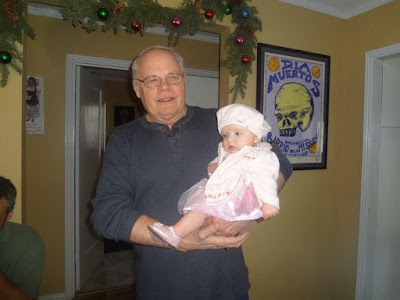 |
MSgt. Roger "Grandpa" Mannon (Ret.)
|
Long
retired from the Army as a master sergeant, he offers this
philosophical opinion of his psychic experience:
“Those
who don’t believe won’t believe despite evidence to the contrary.
And, likewise, those who do believe will continue to despite any lack
of definite proof. The existence of psychic phenomena, like life, is
not cast in black and white but shades of grey and, if one looks,
marvelous things can be found in the shadings.”