Well dammit
I don't care that Martin Cruz Smith thought the movie adaptation of
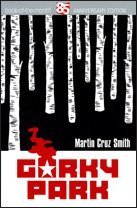
his 1981 groundbreaking novel Gorky
Park
was "dreadful,"
or that the critics thought it was
odd,
or that it drew box
office
yawns. Temporary insanity, the whole lot of 'em. Including Smith! You
may curl your lip at my cinematic taste but I’ll just grin, because
I liked
the movie! A LOT! BOTH TIMES!! [pausing here for a calming moment, in
lieu of having a stroke] But it's the book I'm reporting on now. The
book, which I also liked but which baffled me now and again with its
intricacies and narrative syncopation, both times (go ahead and smirk
if you must—I wasn't the only one, although most of the literary
crowd hyperventilated with joy over it).
Both times I read the book
after seeing the movie. First when it came out, in ‘83. I don't
remember hearing any snoring. I was so raptly fixed on the screen I
don't recall if there was anyone else besides me and my friend in the
theater. I remember having to pee but not daring to run up the aisle
to the men's room for fear something important would happen before I
could run back to my seat. I executed, successfully, what we called
in football practice "water discipline." When the movie
ended, I stopped to pee, staggered out to the car and we drove to the nearest
bookstore.
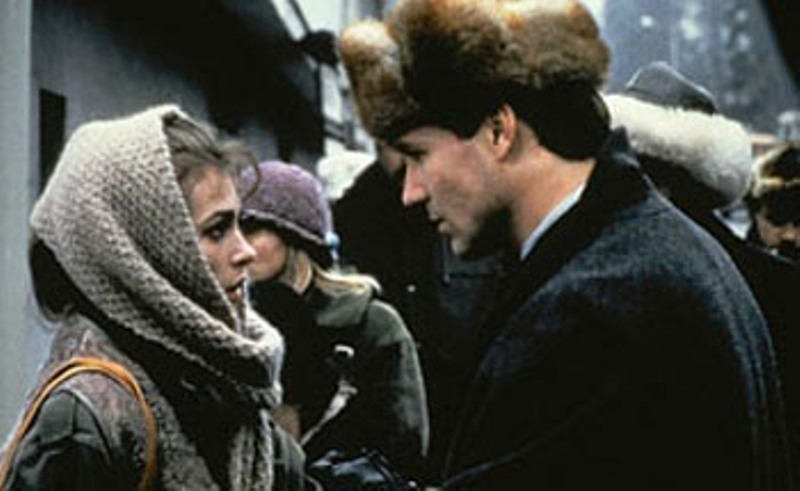
Reading the novel, I was
thunderstruck by how accurately the leading characters matched their
movie depictions. I knew with absolute intuitive certainty that
Martin Cruz Smith when he wrote the book—altho I've not a scintilla
of doubt he'd deny it--had William Hurt in mind for the role of
Moscow Militia Chief Investigator Arkady Renko; Brian Dennehey as
Kirwill, the New York cop whose brother was one of three murder
victims found frozen next to a skating rink in Gorky Park; gorgeous
Joanna Pacula as gorgeous Irina Asanova (Renko's love interest, among
other involvements), and Lee Marvin as the slick, wealthy, worldly
American who trades in exotic furs, among other activities.
Watching
the DVD last week I saw I'd forgotten much of the plot, but then
re-reading the book I again marveled at the perfect choice of actors
for the leading roles. They came alive in the reading as
smart-angsty-dogged Hurt, big-tough-no-guff Dennehy,
beautiful-stubborn-sassy Pacula, and smooth-silvery-teflon Marvin.
One might think that with such strong characters so perfectly cast in
a setting as exotically mysterious as Cold War Soviet Russia the
transition from page to celluloid would be a snap. But while it
worked convincingly for me, possibly because I am easily mesmerized
by well-executed passive entertainment, I can see how the
sophisticate, who’d already read the book, might have expected a
more comprehensive inclusion of the many facets in a novel that
excited critics to gush of Smith as the new le Carré:
“The
most dazzling breakthrough in the suspense field since The
Spy Who Came In from the Cold,”
said the San
Francisco Chronicle’s
reviewer, picking one at random.
And therein
lies the problem, at least for me, with the sort of butterfly
literary narrative that floats about, alighting hither and thither in
a flattering tease of an indulgent readership that would rather risk
getting lost now and then in a garden of thoughts and details than to
admit preferring novels with clearer signage along their story
threads. In a way, the former style, be it post modern, post post
modern or some new style with a name I’ve not yet stumbled upon,
brings to mind the old tale of the emperor who rides nude in his
carriage thru the land believing what
he’s told
by his tailors that he’s clad in exotic new clothing. His subjects,
of course believe as well what they’re told—except for the
innocent child who shouts out the truth. The “child” in this
instance is Peter Andrews in his albeit highly
flattering review
in The New York Times, gently admitting in the final paragraph that
Gorky
Park
“suffers from a flaw...that is common among even the best examples
of the genre. There is a falling-off at the end, when the plot turns
about three notches more than my credulity is prepared to be
stretched. But the first 340 pages were splendid.” My bratty
critique of Mr. Andrews’s faint damning
is that if the foregoing is so splendid how could the ending pose any
trouble at all clarifying the whole? A reasonable answer:
maybe the plot wasn’t handled quite so splendidly if a difficult
ending was needed to wrap things up à
la Raymond Chandler’s The
Big Sleep.
Yet, it doesn’t especially matter with either novel, in the long
view.
I’ve come
to expect the cognitive briar-patch ending with ambitious hybrid
novels that mingle genre and literary. When it works, it’s the best
of both forms. Story with thick glasses. Thing is, for me this
approach is barely an irritant even when it doesn’t quite work,
mostly falling off the page as superfluous style, so long as the
voice and characters are engaging and the narrative thread remains
fairly visible, and the atmosphere has the feel of real. I found all
of these requisites present in Gorky
Park.
Plot, of
course, can be the deal-breaking bugaboo for literary avant
guardists. Too much stink of story alarms their nostrils
and sends them rushing to trusted critics for dispensation. I suspect
it was the contemporary Russian setting that turned the trick for
Gorky
Park—the
better to acquit Martin Cruz Smith for muddling the middle enough to
pass muster with the gatekeepers of highbrow taste. That the book
became a bestseller must have given our literary high priests serious
pause, and it testifies to their courage for admitting in print they
liked the novel despite its popularity.
Part of the plot muddle is the
Byzantine political intrigue of the Soviet Union near the height of
the Cold War, which extended not just to East/West high jinks but to
the internal struggle between the KGB and the militia. This dynamic
is most fascinating as Arkady Renko struggles to solve the triple
murder. His initial focus is on finding an excuse to shuck
jurisdiction by proving the murders were connected to activities of
interest only to the KGB.
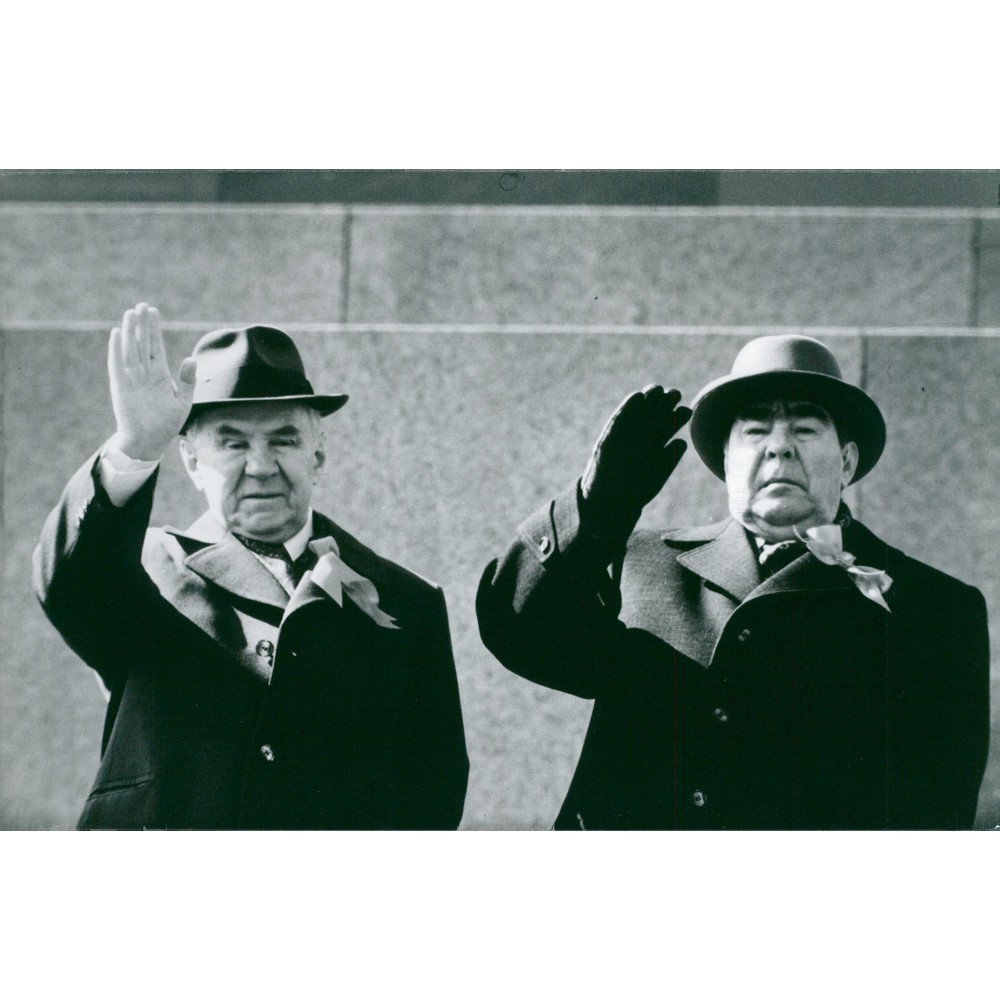
Renko works for the MVD, or
Ministry of Internal Affairs, which is strictly limited to interior
criminal matters, whereas the KGB theoretically is strictly limited
to matters of national security. The two organizations occasionally work at cross
purposes and squabble over
jurisdiction.
He has a
personal history with Major Pribluda, the local KGB chief, which adds
a dangerous dimension to the rivalry. Renko’s sly moves to shove
the case into Pribluda’s lap include requesting KGB tapes of
foreign visitors to Moscow. He’s hopeful when recognizing a voice
on one of the tapes of an international businessman known to be a KGB
friend. If a link could be found between the murders and this
individual, Renko tells himself,
“he was sure Major Pribluda would step in.”
And
this:
“Was it possible–did he have the imagination–to create some
elaborate case full of mysterious foreigners, black marketeers and
informers, a whole population of fictitious vapors rising off three
corpses? All of it a game of the investigator against himself?” One
such “mysterious foreigner,” an American religious extremist,
he learns, was likely one of the victims.
In such a tangle of duty,
history, and politics—international and internal--it’s perhaps
inevitable that Renko, despite being the son of a Red Army heroic
general and the best militia investigator in Moscow, should find
himself at some point under state arrest and in Pribluda’s custody.
Ain’t
no way I’m going to try to describe the plot complications here.
Wouldn’t be prudent. In fact, ‘twould be supremely redundant
trying to reinvent the perfectly good wheel Peter Andrews gave us in
his fine,
brave 1981 review,
especially considering the treacherous ground of opportunities to
inadvertently commit a devastating spoiler. But I can say this:
Arkady
Renko lives to fight another day, and another after that, and
another… He’s become a series character, and has gotten rave
reviews at each outing.
I’m
now reading Red
Square,
which I am liking thus far, A LOT, and expect to report on next
Friday.

[For
more Friday's Forgotten Books check the links on Patti
Abbott's unforgettable blog]