Thursday, October 4, 2018

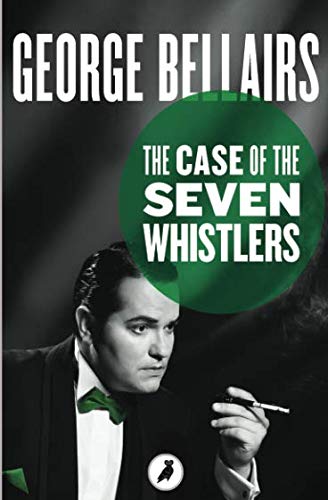
THE CASE OF THE SEVEN WHISTLERS – George Bellairs

When it comes to making me laugh, the power of visual triumphs extravagantly over cognitive--graphically or with words. It's a phenomenon similar to the effect of experiencing a joke versus having it explained.

Take, for example one of the owners of George Bellairs's fictional antique shop, a man referred to only as "Mr. Small" but described in grotesquely comic detail as "an enormous man with a huge paunch which hung between his knees when he was sitting. He had solid limbs like the branches of an old tree and a round florid face. His head was shaped like an orange and topped by a brown, ill-fitting wig. His thick, sloppy lips, large Roman nose, small shifty eyes and ill-fitting clothes finished-off an appearance more like that of a shady broker’s man than an expert in old furniture and prints...so flabbily fat that he looked to be trundling his paunch before him like a railway-porter wheeling baggage about...He was smoking a black cheroot which he kept removing from his mouth and then replacing with a repulsive movement of his lips, like a hungry child taking the teat of a feeding-bottle."
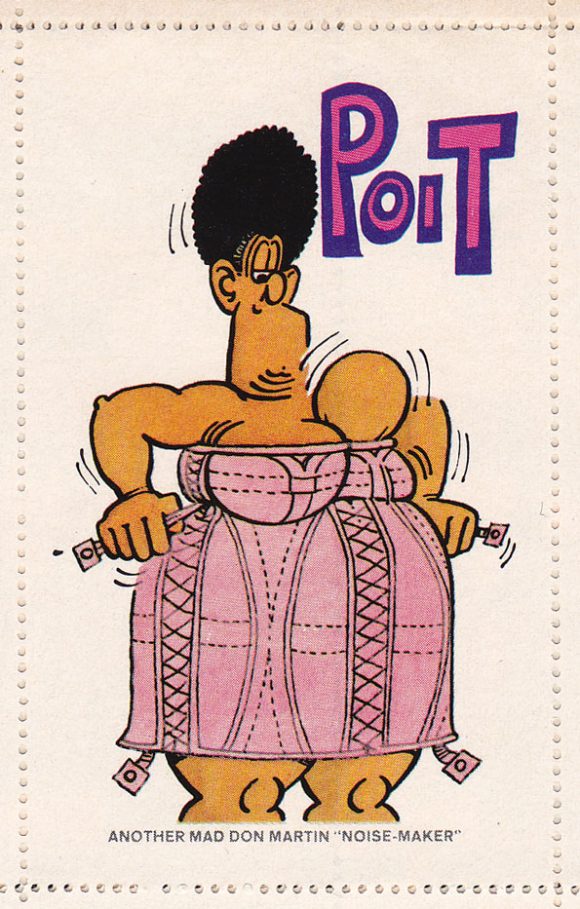
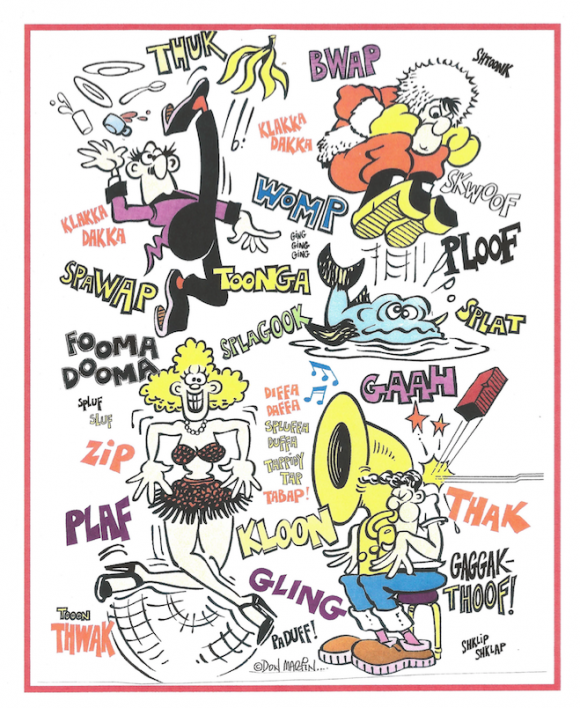
Had Mad Magazine cartoonist Don Martin been working back in the 1940s, and had he and Bellairs perchance collaborated on an illustrated volume of The Case of the Seven Whistlers, Mr. Small, with modified eyes, might have been represented by one of Martin's favorite characters, Fester Bestertester.


Bellairs describes Mr. Small’s niece, Mrs. Doakes, who worked in the shop with her uncle and his brother-in-law, tiny Mr. Grossman, as “a tall, muscular, good-looking woman” with “a way of exciting men whilst putting women out of countenance. Martin might have depicted her thusly, with some essential tweaks:
The entire crew of this novel are portrayed so comically I nearly forgot I was reading a murder mystery, with two violent deaths—one so ghastly I had to wonder if Edgar Allen Poe had gotten a hand in it somehow. Tiny Mr. Grossman is the first victim, found curled up, suffocated, in an antique wooden chest he’d bought from a woman who eventually becomes the second victim, found with her head crushed by either an assailant or rocks at the foot of a cliff from which she’d either jumped or been hurled by a murderer. Tough, I should think, for Don Martin to win laughs with a drawing of that. Perhaps Gahan Wilson could have been brought in for the victim illustrations were time travel an option.
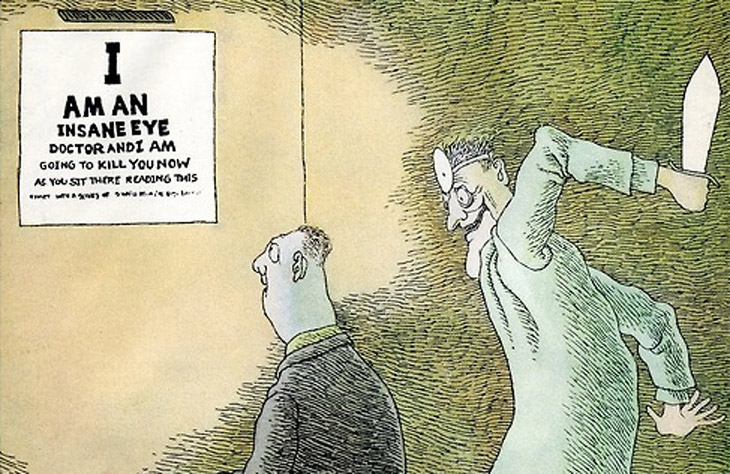
It’s a well-crafted mystery with enough plausible suspects to challenge even the most astute puzzle-solvers, albeit a distinct gullibility in such exercises can challenge my opinion. Anyway, this one fooled me right up to the reveal’s edge. I’m not too proud to blame the thrall holding me captive by Bellairs’s characters. Like a magician’s distracting hands, their general comic weirdness consistently diverted my attention from the story’s Sherlockian signposts. Oh, where to begin?
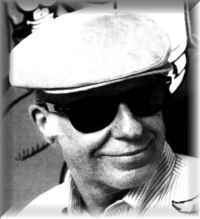
Don Martin
Miss Selina Adlestrop, a spinster whosesmall button nose, like a whiteheart cherry, little heart-shaped lips and a timid, faltering manner...stood her in very good stead and hid her shrewdness in striking a bargain,” which she employed whilst haggling over the chest-cum-coffin with the tiny Mr. Grossman, whose small hands and feet and slim figure and grace of movement of a ballet dancer” attempted to charm from her more quid than she’d have preferred to put out for the item so dear to her romantic heart.
Then there’s the local constable, Donald Puddiphatt, a duffer “perspiring from every pore and puffing like a traction engine as he argued with Seth Hale,” the local undertaker. “They were an ill-assorted couple. One looked to have been poured into his uniform which fitted him skin-tight owing to his ever increasing size; the other was nearly as fleshless as a skeleton with old clothes hanging from his bony body like washing on a clothes horse.
A great brouhaha breaks out when the chest is opened in Miss Adlestrop’s rooming house, and Grossman’s little body is discovered curled up inside. Women faint. One becomes hysterical and has her face slapped by another, and Seth Hale, the skinny undertaker, “fell unconscious to the ground with a great rattle of bones.”
Oh, and there was the local politician, Councillor Blanket, who “ looked made-up for the part of John Bull, like an actor just ready for the footlights. Grease-painty complexion, tufts of hair, bald head with puffs of white at the side,” and Miss Adlestrop’s uncle, Mr. Alfred, a “rabbity” little eccentric inventor “with a squint and a ragged moustache,” who, "ran so fast from the pandemonium you couldn’t see his legs going, like a mouse," with Councillor Blanket in tow, “lumping along steadily, his head held firmly erect to keep his hat from falling off.”
Superintendent Gillespie, in charge of the investigation for the local constabulary, “would go for days without speaking to anyone and then suddenly change into bouts of great jocularity.He always wore his hat in the office when his liver was wrong side out. He said there was a draught from the windows, even when they were closed.” It quickly became clear the case was too much for Gillespie’s force, so his boss, Chief Constable Colonel Carslake, “tall, thin, peppery and self-important,” was forced to call in help from Scotland Yard, hence the arrive of Detective-Inspector Littlejohn, of the Metropolitan C.I.D. A one-man cavalry, who, for some odd reason is not described in any way, presumably because he’s the only character in the novel who doesn’t look or act funny, and Bellairs was relying on reverse imagination to suggest ordinary sanity and appearance.
The coroner, Emmanuel Querk, tall and thin with “a peculiar head...only a little broader than his long neck,” ending in a point from which “a fringe of downy grey hair spread like a curtain over his neck and ears.” A man of multiple quirks, including an aversion to noise, Querk rushed through his inquest into the murder, adjourning it soon after a “hurdy-gurdy started in the street outside just as he was directing the jury and he could hardly wait for their verdict and beating a hasty retreat to his private room. There he locked the door, unlocked a cupboard and took out a bottle of whiskey. It was all that stood between him and the complete madness to which his wife’s endless debts and incessant nagging were driving him.”
Even Bellairs tires of the inquest, giving us a break from monotonous testimony because “we have heard it all before and it would be sheer torture to go over it again in the form of Puddiphatt’s official statement.”
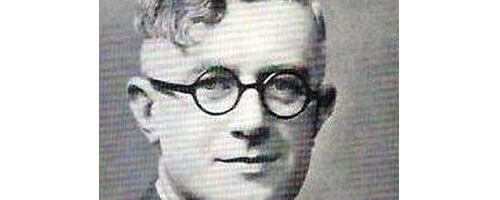
Bellairs
Bellairs evidently has a thing for tweaking clerical noses. In Intruder in the Dark, the first of the Detective-Inspector Littlejohn series I’ve read, he makes fun of the vicar’s “fruity voice.” In Seven Whistlers, the Rev. Mellodew Gryper has “a voice like an oboe” and is shown Ichabod Crane-like at a funeral in which “the mourners had to struggle to keep themselves upright against the stiff breeze blowing from the sea. The parson’s vestments flapped at right-angles to his body. The bearers staggered beneath their burden and tottered from side to side as they advanced to the graveside. Tall, tortured trees surrounded the churchyard, leaning at an angle caused by the fury of the prevailing winds.”
In another scene, conducting sack races for children in a local festival, his oboe voice is grist for sniggering: “‘Oh, what a shame, Bertha. On, on, you’re winning. Ohhhhh,’ he oboed, trying to urge them all on without fear or favour. He sounded at times as though somebody were murdering him, and his contortions suggested that someone might have dropped a wasps’ nest down his pants.”
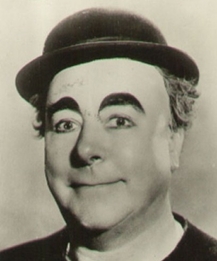
George Robey
One last ridiculous character of the many who tortured my funnybone as I vaguely wondered which one of them might not have been the villain who locked poor itsy bitsy dancing Grossman in the chest and left him to suffocate, essentially buried alive. I give you the insignificant-seeming Mr. Troyte, in a walk-on, walk-off role (perhaps exiting in handcuffs, making wuffing noises as he goes?):a small, portly man who looked like a pug dog with George Robey eyebrows...

He had a pug dog’s teeth, as well, and his voice came from straight behind them, a sort of wuffing noise, thick and unctuous. Like one of Walt Disney’s large, benevolent animals. It gave you a queer sort of feeling when he gave tongue. As though a pet dog suddenly started to articulate...His pug’s nostrils were wide as though from continual deep inhaling and he looked to have blown his teeth half-way out of his gums by vigorously exhaling through his lips...”


[Find more Friday's Forgotten Books links at Todd Mason's amazingly eclectic blog]


Wednesday, September 26, 2018

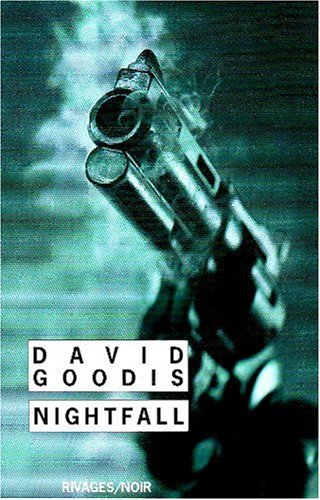
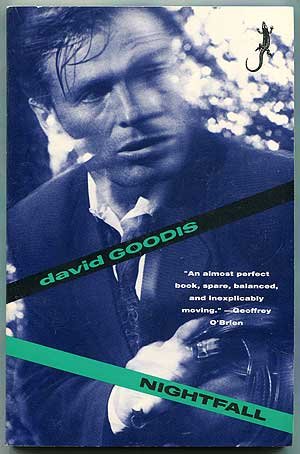
NIGHTFALL – David Goodis

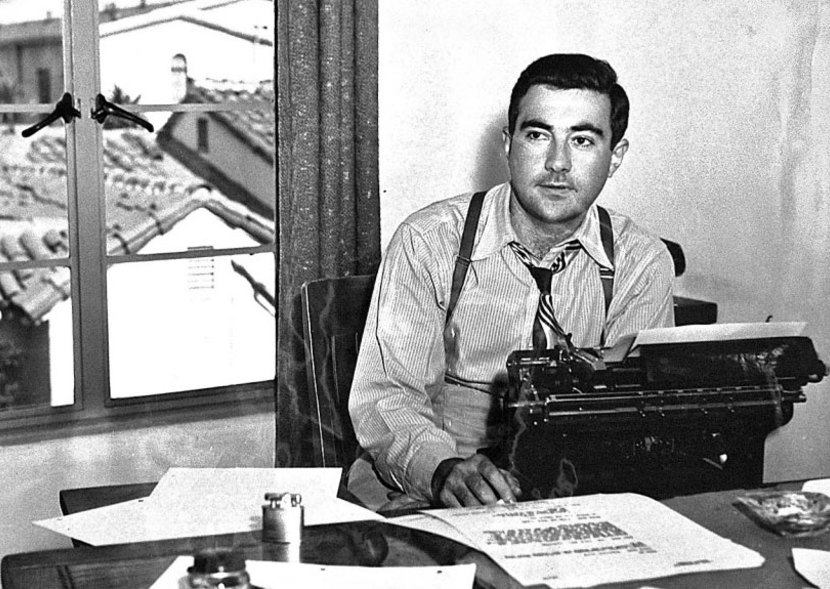
Your name is David Goodis. You’re a guy who lives on luck, whose only talent is stringing words together. Your streak of shitty luck, capped by your wife of two years dumping you last year, might be turning around. Your second novel will soon hit the silver screen with Bogie and Bacall. Time to celebrate. Then again, luck is fickle. You need to bang out another novel. Quick. Why not another dark one, like the lucky one, another Dark Passage? Maybe dark is your metier.
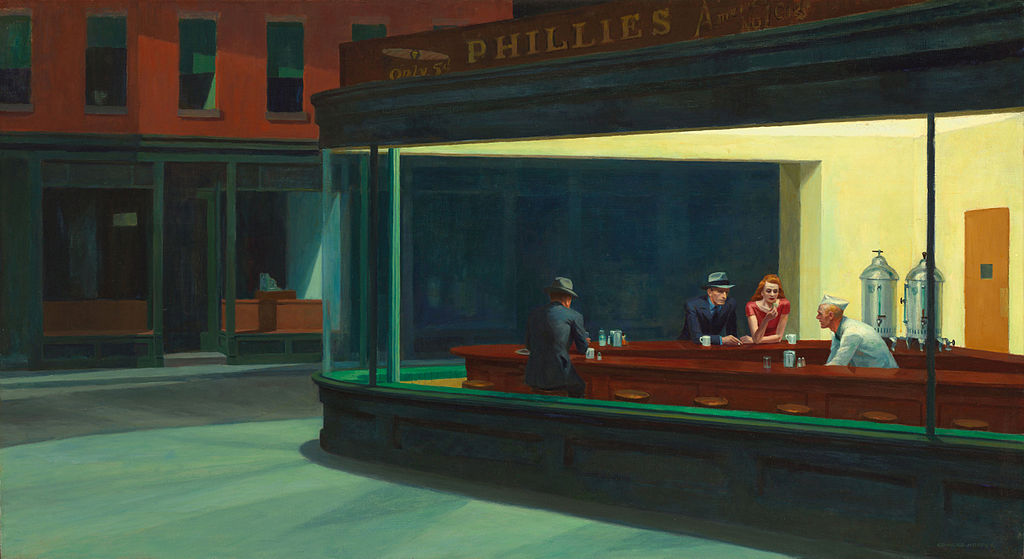
You’re in a bar. A dark bar. You’re in a booth in a dark corner trying to come up with an idea for your next novel while lady luck’s still hanging around. There’s a painting on the wall. A painting of a diner. The diner is well lighted inside but in a dark part of town. Only three people are inside, plus the man behind the lunch counter. The three customers seem lost in thought. It feels like a lonely place. You take out your notebook and write these words:
The place was well off Fourth Street, and the weak yellow light from its window was the only light on the narrow street. Vanning took her in there and they sat at a small table near the window. They were alone in the place. It was very small. Their waiter was the proprietor, and he was a man who looked as if one of his own meals would do him a lot of good. He was trying to be friendly, but weariness prevented him from getting it across. He took their order and went away.

You work out some ideas in your head. Write more words in your notebook. You finish your gin rickey. You have another and you jot down notes until you finish the drink. Then you walk back through the hot sticky night to your lonely apartment. You sit down at your typewriter. You insert a fresh sheet of paper into the machine. You stare at the blank page. You look through the notes you made in the bar. You take a deep breath, nodding your head a couple of times, and you type:
It was one of those hot sticky nights that makes Manhattan show its age. There was something dreary and stagnant in the way all this syrupy heat refused to budge. It was anything but a night for labor, and Vanning stood up and walked away from the tilted drawing board. He brushed past a large metal box of water colors, heard the crash as the box hit the floor. That seemed to do it. That ended any inclination he might have had for finishing the job tonight.
Heat came into the room and settled itself on Vanning. He lit a cigarette. He told himself it was time for another drink. Walking to the window, he told himself to get away from the idea of liquor. The heat was stronger than liquor.
He stood there at the window, looking out upon Greenwich Village, seeing the lights, hearing noises in the streets. He had a desire to be part of the noise. He wanted to get some of those lights, wanted to get in on that activity out there, whatever it was. He wanted to talk to somebody. He wanted to go out.
He was afraid to go out.
And he realized that. The realization brought on more fright. He rubbed his hands into his eyes and wondered what was making this night such a difficult thing. And suddenly he was telling himself that something was going to happen tonight...
Your fingers fly across the keyboard. Ten thousand words a day. You have the title by the time you type He didn't even blink when he heard the sirens, although he knew they were coming toward him and toward no one else. The End
You’re pleased with Nightfall. You know it has flaws. The ending’s not as dark as the other one. You’re thinking Hollywood now. Hollywood’s not ready yet for as dark as you want to go. You know Dark Passage was a lucky fluke. But Nightfall’s got the same milieu. That Edward Hopper loneliness. It’s got suspense and characters and snappy dialogue.
Yeah, the flaws. Dialogue’s all one voice. Interior and spoken for the two viewpoints. Spoken for everyone else. You don’t know women very well. You make them either very very good or horrid. Haha. Like the nursery rhyme. But sometimes you make them so it’s hard to tell. Like Irene and Martha.
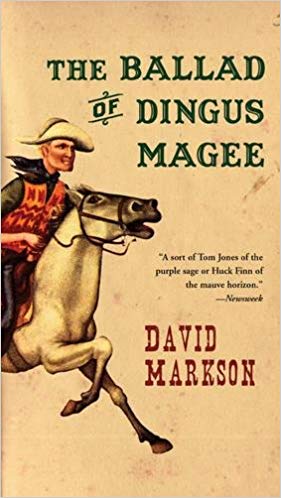
You write roughshod over facts sometimes. Like with the plot. You know police in three states wouldn’t care much if Vanning shot a criminal or that he might have hidden $300,000 from a bank robbery or that they’d compare fingerprints they found on the gun with fingerprints he gave when he bought a car. Fingerprinted to buy a car bwaaahahahaha. You laugh at that shortcut fiction because you know your heart-grabbing characters and breathless suspense and the desperate surreal mood you’ve created will carry your thrill-junky readers as far as you wish to take them. Farther than the Lone Ranger and Dingus Magee and Bogie/Bacall and the Fat Man all in one crazy wild-ass bunch and you know it.
And even tho you have a j-school degree and know damned well no newspaper reporter would dream of calling the Denver PD from New York from a pay phone to find out everything the police in two states know about a nearly year-old homicide and missing three-hundred grand the Seattle bank’s already recovered from its insurance company and get the Denver police to call the Seattle police while you’re waiting in the phone booth and for Denver to relay Seattle’s information back and...hello? Hello...clickclickclick...But you shrug and laugh and make Vanning impersonate a reporter and his editor and get the information this way because your flying fingers and ten-thousand-word daily self-imposed deadline and the story’s furious pace and Hollywood’s insatiable maw and Bogie and Bacall simply won’t allow you to do it the long way.
You pause for part of a second to field a notion that maybe there’s a chance for a spinoff series starring Vanning as the greatest news reporter who ever lived who wins so many Pulitzers he gets bored and drinks himself to death and...But back to Nightfall. Stop with the damned distractions!
And you write paragraphs like this and holy shit you’ll have your readers drooling on the page:
...he saw himself in a mirror, this time the mirror behind the bar, and he saw in his own eyes the expression of a man without a friend. He felt just a bit sorry for himself. At thirty-three a man ought to have a wife and two or three children. A man ought to have a home. A man shouldn't be standing here alone in a place without meaning, without purpose. There ought to be some really good reason for waking up in the morning. There ought to be some impetus. There ought to be something.


Postscript: You die a couple of days following a bar fight nineteen years after publishing Nightfall. You were 49. You’d written 14 more novels, many of them inspiring movies (most of them in France) or TV segments. The film adaptation of Nightfall was released in 1956, nine years after the book, and without Bogie or Bacall. Your books go out of print but have rebounded and are bigger than ever, riding a revival wave of noir. You’ve become a genre classic. That’s something.


[For more Friday's Forgotten Books check the links on Patti Abbott's unforgettable blog]


Monday, September 24, 2018

THIS IS NOT A NOVEL, and Other Novels – David Markson

The word serendipity was born in 1754 when Horace Walpole made it up for a fairytale he was writing. Today, the New Oxford American Dictionary defines serendipity as “the occurrence and development of events by chance in a happy or beneficial way.” This I learned happily reading David Markson’s The Last Novel.
I had not known of Markson or his work until several weeks ago perusing a blogpost’s comment thread. I don’t recall whose blog, or whose rave endorsements of Markson prompted me to look him up on Amazon.com, where I downloaded the Kindle version of This is Not a Novel, and Other Novels, which is actually one long list of quotations, odd facts, and personal observations, broken into three parts, with the third part titled The Last Novel. I learned also that fish feel no pain, and that Thomas Hardy’s first wife, Emma, kept a twenty-year diary devoted to assassinating his character, and that upon her death he burned the infuriating thing.
I learned so so so much more in The Last Novel, which I almost abandoned after the first few pages, for which I am chagrined and embarrassed to the extent I feel an overwhelming pressure to confess—right here right now, in this very space. Some might find it mitigating that I had no idea what I was getting into when I downloaded This is Not a Novel, and Other Novels, thinking it possibly a sort of post-post modern crime novel because the blogpost discussion launching the adventure, which caused me to buy also a David Goodis crime novel, had mentioned that David Foster Wallace was a Markson admirer. (I have resolutely refused even to consider reading anything by David Foster Wallace on grounds he was a darling of the incestuous New York literati, yet his endorsement of Markson did attach a certain twisted cachet in the same vein as Einstein’s having kept a few Perry Mason paperbacks hidden in his Princeton University office.)

I suppose it is possible the Wallace connection, in addition to fancying something different, prompted me to open Markson’s book before Goodis’s. I started with Ann Beattie’s fawning introduction. They were friends, she discloses, and her lengthy literary tribute is “over the moon,” to borrow her phrase. But she pulled me in with this line: “Try to stop reading one of these three novels. Meanings accrue; mysteries arise; you laugh when you least expect to laugh.”
I took it as the challenge it was meant to be, read a couple of pages of each novel, resisting all the way because they weren’t what I’d expected, and clicked the book back into the library. I even opened the Goodis novel, Nightfall, knowing it would be good, but I delayed starting it, bothered by my disappointment with the Markson. Finally opened Markson again and re-read Ann Beattie’s intro. Then I skipped to The Last Novel and started reading again, and before I could again say “What the hell is this thing?” found myself over the moon and on my way to Mars. Beattie was right. I could not stop.
Novel: Wondering when and where the last casual streetcorner conversation in Latin might have taken place.
[I laughed.]
Novel: Dante will always remain popular because nobody ever reads him. Said Voltaire.
[Ditto]
Novel: It Ain’t Necessarily So. In Danish. Which was piped into Danish radio by the underground whenever announcements were made of German victories in World War II.
[Catching the drift?]
Novel: Pietro Aretino died in the midst of a hysterical fit of laughter that apparently turned into an apoplectic stroke. As had the Athenian comic playwright Philemon — at ninety-nine. Or one hundred and one.
[Not only did I have trouble taking a break from reading The Last Novel, I’m having trouble restraining myself from copying all of its lines to this report!]
Okay, one more: Yasser Arafat was reported not to have read one book in the last forty years of his life. But to have spent innumerable hours enrapt by Tom and Jerry cartoons.
Somewhere along my rush through Markson’s astonishing collection of anecdotes, quotes, observations and personal opinions, the serendipitous element I mentioned above was taking shape just beneath the surface of my consciousness: Tangney.
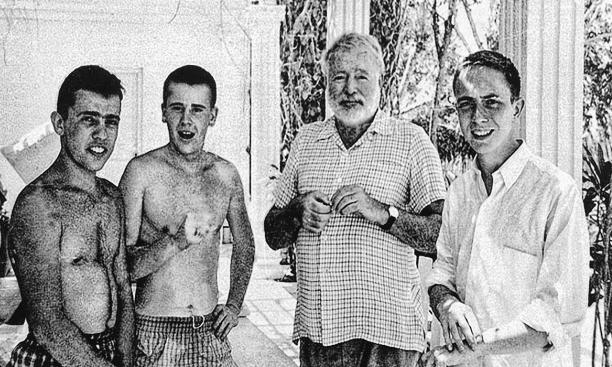
Tangney (second from left)

William E. Tangney, interviewer of Hemingway, discoverer of Einstein’s Perry Mason books, founding editor of the York Town Crier (later changed to its more corporate-comfortable name Yorktown Crier), assembler of anecdotes, quotes, odd facts, and personal observations. Missing friend. I lost touch with Tangney nearly two decades ago after he left Virginia for Naples, Florida. He refuses to communicate online, rarely answers his phone, and never answers letters. Yet, a welcoming and genial host. I visited him regularly when he lived in a book-crammed Yorktown house owned by Mary Mathews, the Greek restaurateur he’d persuaded to pony up the cash to birth a weekly newspaper that’s now owned by a regional chain. Bill is a spellbinding storyteller, a constant reader and compulsive taker of notes. His grand strategy was eventually to publish his assemblage of quotes and quips and curious minutia in a book. I don’t know if this has come to pass. Two days ago I got his address from WhitePages.com and had Amazon.com send him a copy of This is Not a Novel, and Other Novels. It should arrive today. Bill may be piqued by such cheek, but he’ll have some laughs.
Novel: Anthony Trollope was once told by an acquaintance that one of his recurring serialized characters had become boring. Trollope killed her off in the next installment.
[Hahahahaha]
Novel: If it were up to me, I would have wiped my behind with his last decree. Said Mozart — after a demand by the Archbishop of Salzburg for more brevity in his church compositions.
Baldur von Schirach, one of the chief Nazi war criminals tried at Nuremberg, on the origin of his anti-Semitism: From a book about the Jews by Henry Ford.
If on a winter’s night with no other source of warmth, Novelist were to burn an Andy Warhol, qualms? Qualmless.
Pushkin’s beautiful seventeen-year-old wife Nathalie, whom he married at thirty-one — and whom he said was the one hundred and thirteenth woman he had been in love with.
1922. Ulysses.
1922. The Waste Land.


1922. Reader’s Digest.
There are four chances in 2,598,960 of being dealt a royal flush in a hand of poker.
How old would you be if you didn’t know how old you was? -- Satchel Paige.
Please return this book. I find that though many of my friends are poor mathematicians, they are nearly all good bookkeepers. -- Walter Scott’s bookplate.
No battleship has yet been sunk by bombs. Said the caption on a photograph of the USS Arizona in the program for the 1941 Army-Navy football game — eight days before Pearl Harbor.
Never having realized that there originally once was an actual troublemaking Irish family named Hooligan.
Or a military officer named Shrapnel.
The John Cage composition entitled 4’33”, in which the performer sits at a piano for four minutes and thirty-three seconds — and plays nothing.
Wondering if there can be any other ranking twentieth-century American poet whose body of work contains even half the percentage of pure drivel as Wallace Stevens’.
A sort of gutless Kipling, Orwell called Auden.
I’m going. I find the company very uncongenital. Says someone in a Gypsy Rose Lee mystery.
The French government provides the Paris Opera a subsidy of roughly $ 135,000,000 each year. The United States gives the Metropolitan Opera less than $ 1,000,000.
[potato chips for the curious, good-humored mind]
Abject bottom-licking narcissism — Martha Gellhorn found in Hemingway.
Morningless sleep, Epicurus called death.
One would like to curse them so that thunder and lightning strike them, hell-fire burn them, the plague, syphilis, epilepsy, scurvy, leprosy, carbuncles, and all diseases attack them. Ignorant asses. -- Martin Luther, in a contemplative mood re the papal hierarchy.
A writer of something occasionally like English — and a man of something occasionally like genius, Swinburne called Whitman. A man standing up to his neck in a cesspool — and adding to its contents, Carlyle called Swinburne.
It is utterly impossible to persuade an editor that he is nobody. Said William Hazlitt.
Comedy aims at representing men as worse, tragedy as better, than in actual life. Says Aristotle.
Berlioz read every Fenimore Cooper novel as quickly as it appeared. And admitted that fully four hours after he finished The Prairie he was still weeping over the death of Natty Bumppo.
A dreadful old fraud, Edmund Wilson called Robert Frost. A sententious, holding-forth old bore who expected every hero-worshipping adenoidal little twerp of a student-poet to hang on his every word, James Dickey would elaborate subsequently.
The eighteenth-century evangelist George Whitefield. Whose pulpit voice was so effective, said David Garrick, that he could make listeners laugh or cry by no more than pronouncing the word Mesopotamia.
Dear President George W. Bush: Herewith please find uncorrected proofs for the newly discovered rewritten version of Heidegger’s Sein und Zeit. Kindly limit your review to twelve thousand words. Thank you.
Remembering that Charles Darwin is buried in Westminster Abbey.
For no reason whatsoever, Novelist has just flung his cat out one of his four-flights-up front windows.
[several pages later:
Novelist does not own a cat, and thus most certainly could not have thrown one out a window. Nonetheless he would lay odds that more than one hopscotching reviewer will be reading carelessly enough here to never notice these two sentences and announce that he did so.
I am no Einstein, once said Einstein.
Listen, I bought your latest book. But I quit after about six pages. That’s all there is, those little things?
[And I still have the first two lists of “those little things” to read!]


Thursday, September 20, 2018

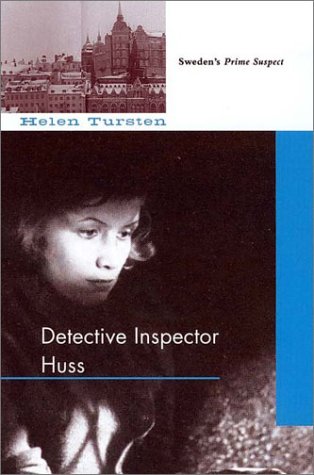
DETECTIVE INSPECTOR HUSS – Helene Tursten

Still reeling with hangover from Martin Cruz Smith's eight-novel vodka-sodden Arkady Renko crime series, I felt the need for a freshening change somewhere a tad more wholesome. Sweden seemed just the ticket, I decided, after reading Bitter Tea and Mystery blogger Tracy K's enticing review of a novel by Helene Tursten. I forthwith downloaded Tursten's first in her series featuring Irene Huss, a detective in the Göteborg Police Department's Violent Crimes division.
The opening scene in Detective Inspector Huss was so startling I came close to hopping into the pickup for a run to the ABC store to pick up a fifth of Beluga in case I needed to chase away what I assumed were lingering Renko demons. In the scene, a filthy rich international financier plunges to his death from his high-rise apartment in Göteborg. That’s precisely how Wolves Eat Dogs begins, except the filthy rich international financier who splats awkwardly on the street below his high-rise apartment is in Moscow. Renko and his vodka-swilling sergeant had to fight bureaucrats, international criminals, and maniacs for the entire novel before determining whether the Russian financier was murdered or committed suicide. It took Göteborg’s medical examiner several seconds to decide the Swedish financier was murdered, and Huss and about a dozen Göteborg detectives and forensic technicians, the rest of the novel, with cooperation from everyone except the suspects, to know whodunnit and why.
Pure police procedural. Twice longer than I prefer in a crime novel, but ultimately a satisfying depiction of the problems, strategies, and techniques involved in a complicated, high-profile investigation.
My only nit to pick with the plot structure is the investigating team coming off as too experienced, too well oiled for what we are told at the beginning: “Glamorous TV murders like the von Knecht case almost never occurred. But when they did, the police were completely at a loss. Suddenly there were all kinds of tender toes they had to avoid stepping on. They couldn’t proceed in their usual way with the investigation.” True, the detectives were restricted to the book—no rubber hoses—when questioning the usual suspects, and they did, the only deviation being Detective Inspector Birgitta Moberg kneeing a suspect in the balls after he shoved her against a wall and grabbed her crotch. The “cute, young, blonde” detective suffered sexual harassment as well from at least one of her male colleagues, but only with words and pornographic pictures. (I learned that her colleagues outed another male team member, in a later novel in the series, as the sender of the pictures.)
The novel doesn’t shy from addressing the tensions in a traditionally male police force dealing with female members, but Tursten handles the issue without the stridency one might expect in modern fictional treatments. There’s an earnest rudder steering the conflicted sensibilities through these unfamiliar waters. The team’s boss, Supt. Sven Andersson, struggles with his own biases, constantly correcting himself mid-word when slipping into locker-room language referring to women, and Det. Inspector Irene Huss, a former European judo champion, has won respect as a veteran of the force. Andersson, who also has issues with aging, including his own, quickly apologizes to Huss, excluding her from his reference to the local female prosecutor as “another old crone.” But Huss reflects to herself: “Again the problem of attitudes toward middle-aged, competent women. Why were they so intimidating? She realized that she herself was well on the way to joining this group of women. But Andersson never seemed to feel threatened by her, even though she was a bona fide expert detective. Evidently because he knew her and liked her, in his eyes she never grew older.” 
Göteborg
No one objected, however, when Andersson used an unflattering metaphor to describe the imperious medical examiner, Yvonne Stridner, “undeniably one of the country’s most talented pathologists,” we are told. After viewing the body on the street and pronouncing it a murder, “she hurried off...Irene watched her go and said, ‘She’s actually quite human.’
Andersson snorted. ‘Human, her? She’s got the emotional life of a backhoe!” This gave me my first genuine laugh of several throughout the novel. Having a bad day, Huss tried to remember a song to describe it, wondering if it was one of Frank Sinatra’s. She gave up. “Didn’t make a damned bit of difference which old fart it was. It was a rotten day even before it got started. And after it worked for her on a subway she shared a trick for handling people who stare at you in public: “She gave the woman in the suit a radiant smile and sat down. That’s the most effective way to startle people: They think you’re crazy and instantly avert their eyes.”
The novel pokes into other current societal issues that involve the detectives and their suspects.
Huss visits a young man dying of AIDS, whose mother tells her his condition is so bad he must be fed intravenously: “That’s not something I can take care of. Thank the good Lord that the national health-care system is still functioning!”
There are drug-dealing biker gangs and racist skinheads. One of Huss’s two teenage daughters shaves her head to join a punk band spewing anti-Semitic lyrics that advocate killing Jews. The girl argues that it’s the music that interests her, not the lyrics, but when Huss presses her the daughter claims the Holocaust was fiction. Huss then invites one of her colleagues to dinner with her family (her husband’s a professional chef), and in a deeply moving scene the detective tells the story of his own family. His mother’s father was unknown, a young Nazi who participated in a gang rape of the detective’s Jewish grandmother. Shocked, but still disbelieving, the Huss daughter runs to her room and slams the door, sobbing loudly.
Larsson borrows a Finnish detective from another division to interview a Finnish woman who cleaned the financier’s apartment. Finnish immigrants, we learn, are a disrespected minority in Sweden.
The story takes place over the days leading up to Christmas, but Göteborg, second only to Stockholm as Sweden’s most populous city, is having trouble getting into the holiday spirit, what with seemingly endless icy winds and freezing rain. It didn’t help that retailers had started their push earlier than usual in order to “suck as much as possible out of people now that income tax refunds weren’t paid out at Christmas anymore.”
Helene Tursten
I hit a speed bump early on, when Tursten described in minute detail the pricy features in the financier’s luxurious apartment. Too much detail can easily clog a narrative, robbing me of the pleasure of using my imagination from just a bare sketch of details as cues. Ordinarily I’m apt to abandon a novel were such distractions to persist. Possibly it did with Detective Inspector Huss, but if so, the narrative was so smooth and tightly written I was able to skate over unnecessary (to me) descriptive sections without losing track of the story. I’m curious to see how Tursten’s craft and her characters develop in subsequent outings of Irene Huss’s team. As they apparently have not all been translated into English, and those that have are not in sequential order, I have yet to decide which one I should choose next.


[For more Friday's Forgotten Books check the links on Patti Abbott's unforgettable blog]