Thursday, September 13, 2018

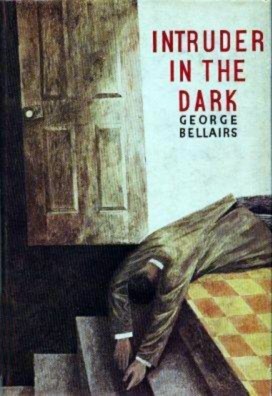
INTRUDER IN THE DARK – George Bellairs

Undoubtedly cosmic convergence has conspired to bring Doc Martin into my life simultaneously with the advent of my first Chief Superintendent Littlejohn crime novel. Of course I cannot rule out the powerfully psychic influences of Yvette and Donna. Yvette, a fellow book blogger, has been gently urging me for months to give the Littlejohns a try; Donna, my morning walking buddy, described some characters and situations that amused her on the BBC's Doc Martin series, which I found in our public library's DVD section. It hadn't occurred to me when I started both at about the same time that the genius of the show and the novels is their intriguingly, hilariously unforgettably nasty characters.
My favorite of the bunch in Intruder in the Dark is the murder victim –stupid, raging, cowardly bank clerk Cyril Savage. He's the sort of jerk you egg on when he starts kicking open the locked cellar door you'd yell NO! NO! DO NOT OPEN THAT DOOR!! were it someone else--almost anyone less obnoxious--about to enter the cellar where you know evil lurks. With Savage I found myself shouting YEAH, YOU STUPID FOOL, KICK IT OPEN! GET WHAT'S COMING TO YOU!! (I was so loud I expect my landlady will have words with me tomorrow when I pay the rent. At least none of the neighbors called 911.) My laughter when Savage got what was coming to him was almost as loud, and quite fiendish, and the only reason I wanted Chief Superintendent Littlejohn to crack the case was my hope someone would pin a medal on the murderer.
I should note it wasn't me who labeled Cyril Savage a "cowardly bank clerk," altho I have no deep affection for bankers as a predatory species. The culprit who created Savage—George Bellairs, aka Harold Blundell--was himself a banker, and evidently knew whereof he wrote about the do-I-knooow-you? type.
Despite his being a banker, one may assume Bellairs/Blundell considered himself a manly man, as he treats Vicar Luttrell (a very minor character, thankfully) with the contempt the stereotypically manly man enjoys dumping on the stereotypically less masculine of his gender, by dismissing him as having "a round fruity voice." Then again, B/B might simply have disliked clerics, or at least this one, altho the round-fruity-voiced Luttrell has little more than a walk-on/walk-off role, perhaps just enuf exposure to give us a laugh at his round fruity voice (the late Truman Capote did come to mind).
Other characters. Oh, my goodness, as Vicar Luttrell might have said with a flap of a hand, they're all so deliciously despicable. I've no choice but to narrow them down. Let's start with P.C. Green, the slow-witted local constable--"a good humdrum bobby"--who's trying to impress Littlejohn and his Scotland Yard partner, Inspector Cromwell, with his competence:
"Green opened a drawer in the desk and took out a large black notebook, which he opened and placed before him. He’d been expecting this, had got all his points in what he considered to be order, and even rehearsed it with his wife. And at the end of the recital Mrs. Green had solved the case and suggested the arrest of Mrs. Savage, who, she said, had obviously done it!" Fortunately the constable's shrewish wife, "the powerhouse of the outfit...small and fair and given to fixed ideas which she relentlessly pursued," was wrong, or we would not have had the pleasure of meeting the other nutjobs in Plumpton Bois, where murder was as rare a phenomenon as sanity.
I don't mean to dismiss Green's wife as a suspect, however, as her ambition is a driving force. "You want to end up at least as an inspector," she shrills at her husband. "Myself, I’m not content to finish up in Plumpton. Besides, we’ve the children to think about..." Aha! One hopes the Yard boys keep an eye on that one.


The standard Igor type makes a cameo appearance as Hank, the handy-man, "who filled the posts of hall-porter, barman, taproom waiter and chucker-out. He looked like a retired punch-drunk boxer." His boss, the lazy no-account owner of Miner's Arms, the inn (the only inn) where Littlejohn and Cromwell stay during the duration of their investigation, and the boss's shrewd wife, are early suspects, and one can never quite rule them out, because they aren't quite suspicious enuf to be innocent. I'll leave it there.
There's Mr. Hubbard, chairman of the local ruling council, a "cocky little shrivelled-up old man with the facial tic" who once romanced Melody Johnson, who'd bequeathed on her death the old Johnson mansion to the horrible Cyril Savage her only known livng relative (her bastard son, who was believed to have been killed in WWII, was presumed to be carrying Mr. Hubbard's DNA, but Hubbard had left her at the altar, so the gossip said, and technically wouldn't have qualified for any inheritance, etc. etc.)
Perhaps my next favorite unlikable character is Mrs. Murphy, who ran "The Stores," a general store that had handled the town's mail before a real post office took over, leaving Mrs. Murphy still the store owner and a confirmed busybody, but bitterer and bossier than ever. You know she couldn't be the murderer, which means she just might have been the one who brought the raging, pusillanimous banker to his well-deserved doom.
But oh mercy, no way I can leave out "Old Cunliffe," Melody Johnson's lawyer. who seems to have inherited the piddling cash left in her estate. She'd fallen on hard times, and her only property was the old house her father had built above his now long-defunct lead mine. Some townspeople believed she'd stashed a bundle of cash in the basement (are we catching on a tad here?) "Old Cunliffe was probably her only remaining friend from the old days," the local physician tells Littlejohn. "He did a lot for her during her lifetime and, as she had nobody else to leave it to, she passed her cash on that way. It’s also well known that Cunliffe is very hot on the money and makes a habit of reminding clients when they make their wills that it’s customary to leave what he calls a small memento to the lawyer. His wife is a very extravagant woman and he’ll need every halfpenny he can come by to make ends meet."
Too suspicious, no? I mean, the guy had motive and means (a key to the house) and, altho he was another old coot, might have been strong enuf to whack the cowardly banker over the head with a crowbar under the circumstances, we know in these crime mysteries it's NEVER the obvious suspect who dunnit. And yet...
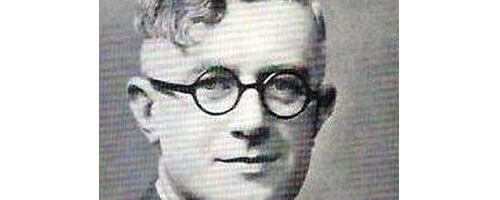
Bellairs/Blundell modeling hip new haircut

There are more suspects and nutty characters, and some great dialogue and words, such as Constable Green's wife having..."titivated him up a bit" before he left home for the office (it's British, you'll have to use your imagination).
The only characters not leaving much impression are, oddly, Littlejohn and Cromwell. We're told Cromwell dresses like a dandy, but we don't have clue as to how Littlejon dresses or if he wears any clothes at all. We get no idea how he looks or walks or—oh, wait a minute, I just remembered, in one scene he lights a pipe! But there's no personality. He's just a voice asking questions. Same with Cromwell. I can't identify with either of them other than that because I have no sense of them I can become them. It's a strange experience. If this was B/B's intention it's daringly original, possibly. Certainly not elementary.
Then again, Intruder in the Dark came out in 1966, about midway thru the fifty or so Littlejohn novels. Maybe by then he expected his readers to know the two Yard men so well reminding wasn't needed. Now I suppose I shall have to start at the series beginning. I do kind of wonder, for example, if Chief Superintendent Littlejohn has a first name or wears an Inverness or perhaps vomits at the sight of blood...oh, wait, that's Doc Martin.


[For more Friday's Forgotten Books check the links on Patti Abbott's unforgettable blog]


Thursday, September 6, 2018

IN RE: SHERLOCK HOLMES – THE ADVENTURES OF SOLAR PONS BOOK 1 – August Derleth

As the strong man exults in his physical ability, delighting in such exercises as call his muscles into action, so glories the analyst in that moral activity which disentangles. He derives pleasure from even the most trivial occupations bringing his talents into play. He is fond of enigmas, of conundrums, of hieroglyphics; exhibiting in his solutions of each a degree of acumen which appears to the ordinary apprehension preternatural.
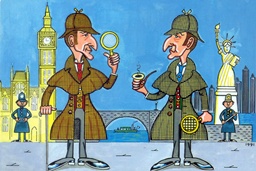
Solar Pons to a T, or Sherlock Holmes, actually, as August Derleth had wanted to call his ratiocinating private detective until Arthur Conan Doyle, who’d decided not to write any more Holmes stories, told him “No.” Undaunted, Derleth came up with a new name for the star of his Holmes pastiches, giving birth to Mr. Pons. It should be elementary to wonder what credit, if any, Doyle himself gave to the creator of Holmes’s precursor, Monsieur C. Auguste Dupin, as the quotation above, which describes Dupin to the same T as it does Holmes/Pons, was penned by Edgar Allen Poe in his prologue to The Murders in the Rue Morgue, a story first published in 1841. My exhaustive research has turned up no evidence of legal threats by Poe’s literary guardians to prevent Doyle from naming his detective Dupin, nor any inkling Doyle had even the slightest interest ever in doing so.
A disclaimer of sorts is appropriate at this point, as I should disclose a marked aversion to ratiocination despite the amusement of trying to pronounce it perfectly ten times in a single breath whilst keeping in mind precisely what it means. The aforementioned prologue to Rue Morgue provides a terrifyingly complex explanation of how the mind of Dupin/Holmes/Pons solves mysteries no other living soul could ever hope to fathom without extraterrestrial or exotic chemical assistance.
C. Auguste Dupin
I suspect my disinclination to embrace mystery-solving by means of such techniques as determining beyond doubt from a barely visible filament of wool adhering to a pants cuff that the wearer of said pants had arrived aboard the Orient Express, Coach #7, from a remote village in Bangladesh...uh, where was I? I don’t have patience for such folderol unless it appears in something light and short, such as August Derleth’s quickie, deftly crafted stories featuring Solar Pons and his faithful assistant/stenographer Dr. Lyndon Parker. The collection’s odd title, In Re: Sherlock Holmes – The Adventures of Solar Pons Book 1, is an homage to Derleth’s debut Pons collection’s homage to the forbidden Holmes. Shamefully, having grown up an hour’s drive from Derleth’s home town in Wisconsin, it’s the only one of his many works I have read, and read only after the cumulative guilt from reading Friday’s Forgotten Books blogging friends’ enthusiastic reviews of Derleth’s work finally last week nagged my fickle forefinger to the one-click download button on Amazon.com’s Kindle version of In Re...Book 1. [breathe]
Holmes v. Pons


So why did it take me so long to “discover” August Derleth? Let me list some pathetic reasons:
  • His work wasn’t taught in my schools because he was local, and therefore not a “serious” writer.
  • I didn’t know he wrote Sherlock Holmes pastiches. Yet, altho I went thru a serious Holmes phase years ago, I was never tempted to join the Williamsburg, Va., chapter of The Baker Street Irregulars.
  • My dad bad-mouthed him, thinking him not a “successful” writer (he was hoping to discourage my interest in writing), which meant he was “a little nuts,” altho my dad had tried to write a mystery and abandoned it after a couple chapters and warned me not to tell anyone because people would think him “a little nuts” (one was always “a little nuts” until one actually wrote a novel that made a lot of money, altho every now and again he’d assure me that “everybody’s a little nuts” (he was a lawyer and had to cover all of the bases, win every argument), but then August Derleth was really nuts because “HE MARRIED A TEENAGER!!!I was barely a teenager myself when on one of our family visits to Madison to “eat out” he pointed at Derleth with a young woman walking near the Capitol. THERE HE IS! LOOK AT HIM WITH HIS TEENAGE WIFE!!! True, Derleth looked old enuf to be the woman’s grandfather, and, back then and at my impressionable age, pretty much completely under the thumb of an egomaniacally fucked-up father, I agreed, with a murmur, thinking the man might have been at least somewhat nuts. And, sad as it is to recognize and acknowledge, this likely was the emotional toxin that kept me from August Derleth’s work until last week.
So, then, did I enjoy the dozen Solar Pons adventures contained in this collection? Elementary, my dear friends. I’d forgotten how much fun I’d had reading Arthur Conan Doyle’s stories, and I found some neat treasures in the Pons stories, to boot, which I shall present as little mysteries for you to solve. The game is now afoot!

August Derleth
From The Adventure of the Sotheby Salesman, something in this quote should remind you of another, more popular fictional detective (hint – one of his most outrageous cases involved tweaking the ego of a certain powerful Washington, D.C. bureaucrat): For some moments Pons stood gazing with rapt interest at the lowered window, his eyes slightly narrow now, his lips pushing out and in in his customary fashion when deep in thought.”
Answer aloud what bell doth ring in this quote from The Adventure of the Purloined Periapt: “I have used these lads before your time, Parker. And no doubt I shall use them after. They are remarkably alert. I call them my Praed Street Irregulars.”
And this, from The Adventure of the Seven Passengers (you may shout it out):Pons regarded Baron Ennesfred Kroll as the prototype of the arch-criminal, and found himself ultimately involved in several adventures in which he recognized the hand of the baron, before he was enabled to trap him.”
Delightful as these stories are, I found myself thoroughly absorbed in the background on August Derleth and Solar Pons provided by three devotees: David Marcum (Regarding Sherlock Holmes), Derrick Belanger (Many Firsts), and Vincent Starrett (In Re: Sherlock Holmes).
I wish to hell someone had led me to August Derleth’s enchanted world long ago...long, long ago. 


[For more Friday's Forgotten Books check the links on Patti Abbott's unforgettable blog]



Wednesday, August 29, 2018

LAST BUS TO WOODSTOCK – Colin Dexter

After a fitful ride on Last Bus to Woodstock I doubt I shall read anything more by Colin Dexter. Ever again. I can't remember when a book has disappointed me—angered me—as much as this first in Dexter's thirteen-book series of Inspector Morse crime novels. I admit it would be convenient to put the blame on someone other than myself for steering me there, but I can’t. Not even my crime-blogging friends, whom I’ve let persuade me to try authors I’d never heard of. Nope, not this time. I’m stuck with it. Taking a cue from Jimmy Buffett’s Margaritaville, it's my own damned fault.
I say this by way of cautioning readers who enjoyed the TV series based on Dexter’s characters: Inspector Morse, its spinoff sequel Inspector Lewis, and its prequel, Endeavour (which is Morse’s first name). I haven’t yet seen any of the Morse series, but I’ve watched some episodes of Lewis, and of Endeavour, and enjoyed them immensely. Ordinarily if I like a film based on a book, I’ll give the book a shake. And I’ve found more often than not the original’s even better than its screen adaptation, or at least is engaging and entertaining in its own way. This was the case with the Inspector Gently TV series. The lead character in Gently Does It, the first of Alan Hunter’s forty-six books featuring the North British detective, was quite different from the TV Gently. It took some getting used to, but I enjoyed the read. Not so with Last Bus to Woodstock, which presents Inspector Morse as an unintentional (I’m guessing) parody—something as unpleasant to imagine as, say, Adam Sandler portraying Sherlock Holmes.

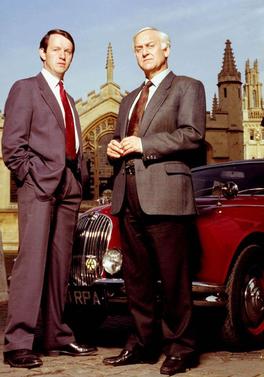
Kevin "Lewis" Whately" and John "Morse" Thaw
 
I should note that while the author handled the murder mystery competently, worthy of the TV series, his detective is boring and arrogant. Morse treats his assistant, Sgt. Lewis, with such contempt I felt at times like reaching into the story and slapping the feces out of Morse. In a bar, for example, while the two are interviewing witnesses in the murder of a young woman found outside with her head bashed in, the bartender offers Lewis a beer. “He’s on duty,” Morse snaps, but accepts a drink himself.
In fact, it appears Morse is a delusional lush. Sitting in his office, “mildly drunk,” he believes he’s gaining some insight into the case. “His mind grew clearer and clearer. He thought he saw the vaguest pattern in the events of the evening of Wednesday, 29 September. No names–no idea of names, yet–but a pattern.” Yeah, right.
At another time, stuck at home recuperating from an injury to his foot from falling off a ladder, Morse bores Lewis with rambling theories about the case, not allowing Lewis to comment or question anything he says. “A quarter of an hour later a bewildered sergeant let himself out of the front door of Morse’s flat. He felt a little worried and would have felt even more so if he had been back in the bedroom at that moment to hear Morse talking to himself, and nodding occasionally whenever he particularly approved of what he heard coming from his own lips.
“‘Now my first hypothesis, ladies and gentlemen, and as I see things the most vital hypothesis of all–I shall make many, oh yes, I shall make many–is this: that the murderer is living in North Oxford...” In fact, Morse has no evidence at all for this or any of his other screwball assumptions. I found myself screaming silently at one point, and suddenly bursting out laughing, as the long-suffering Lewis, the author tells us, “wished he’d get on with it.”

Kevin Whately

Another thing I found annoying was the multiple-viewpoint narrative. We’re inside the heads of most, if not all (I didn’t keep track) of the suspects, which, I know, is a perfectly valid literary device, but for me it doesn’t work in a mystery—or at least in this mystery, as the characters are stereotypes, thus less interesting than had they remained mysteries themselves, known only through the detectives’ sensibilities. In Last Bus to Woodstock none of the characters whose heads I was allowed to enter aroused my suspicion, despite some clumsy “clues” tossed my way. This left as likely suspects the few I knew only as Morse knew them. Presumably a craftier writer could bring off having a character we feel we know revealed as a surprise in the end as the murderer, but I cannot recall an example where such was the case, other than in a straight procedural plot.

Colin Dexter
 
I found the setting interesting—Oxford and its academic environs. Several minor characters are academics, and we get much byplay in this milieu—credible because of Dexter’s background as a classics teacher. I bought a three-book collection with my Kindle download. Unless I experience a brain transplant or a metaphysical change of heart, I shall not be reading either of the other two.
But I do intend to borrow the public library’s Morse/Lewis DVDs. I know they’ll be good!


[For more Friday's Forgotten Books check the links on Patti Abbott's unforgettable blog]
Thursday, August 23, 2018

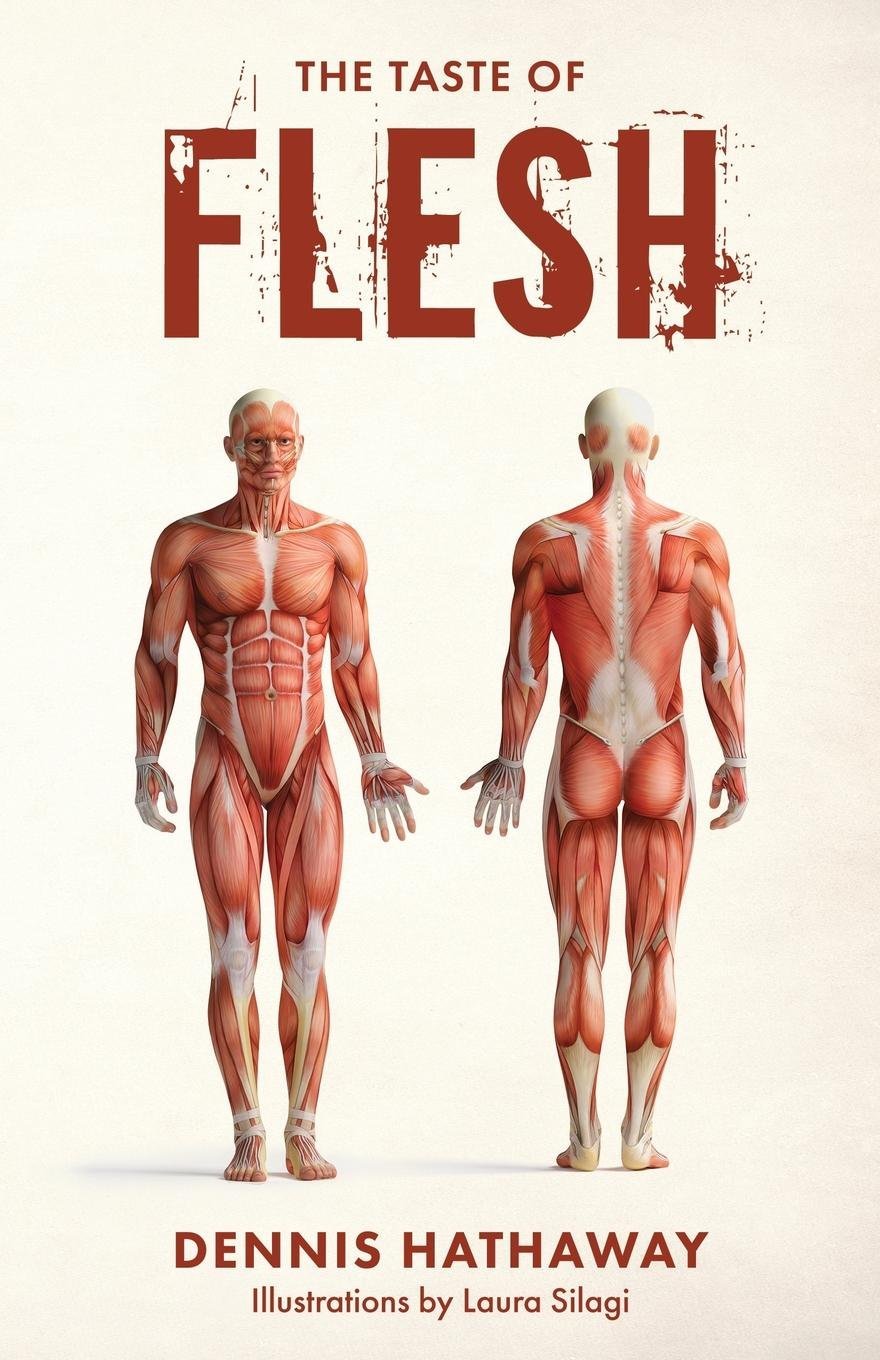
THE TASTE OF FLESH – Dennis Hathaway

For me a good poem slips in through the layers of cultural conditioning with enough startle and spin to bring focus and context to errant idea fragments and give the familiar a fresh and knowing face. Good poems touch me in ways that are hard to describe beyond the usual adjectives. Complicating this difficulty is my vast academic ignorance of poetry, its traditions, and subsequently the conventional critical language that poetry scholars rely on to define whether a particular work meets certain acceptable standards. A saving grace for me is knowing that many poets celebrated today prevailed over disfavor from the scholars of their day.
My own feeble efforts penning the occasional verse have given me a respect infringing on awe for wordsmiths who dare to tread beyond the boundaries set by those who’ve gone before. Dennis Hathaway is one of those select few. His first collection of twenty-five poems, The Taste of Flesh, follows his story collection, The Consequences of Desire, which received the 1992 Flannery O’Connor Award for Short Fiction.


As I am unqualified to render a conventional review of The Taste of Flesh, I shall instead give you select snippets of its exquisite wordplay, its stunning visuals, humor, and delicate, soul-deep probes, many that left me slack-jawed, unable even to mumble the superlatives struggling up from somewhere near the heart.
These lines are from Cream, a reminiscence from his childhood on a Midwest farm:
He will remember the snow drifted against the barn,
He will remember the horses that bolted, or kicked, or otherwise misbehaved, Like surly children;
He will remember those children, and his wife, and his own father,
Dispensing wisdom that went down like medicine,
And he will feel that straggling line of ancestry,
Disappearing into the past.
And then he will sigh, and all will be quiet, and gone.


And this from the poem. Father, which has a Faulknerian feel:
And thus the son says, Goodbye.
Your strength, your endurance, your aphorisms,
They will settle with you into the earth
Which goes on, which persists despite our wanton recklessness,
And into the dust will settle anger, resentment, guilt, sorrow,
And you will be remembered,
And loved.


And here’s a little whimsy—with bite--from The Invention of Ideas:
It would be interesting (for someone)
To examine the persistence of failed ideas.

Propositions that don’t bear scrutiny.
For example: The trickle-down theory.

Why not the trickle-up theory?
Money in
The hands of the poor will find its way to the rich

Who own the banks, the fast-food franchises,
The automobile dealerships.

For aren’t ideas really gasps of confusion?
Smeared ink? Blackboards imperfectly erased?

For example: The trickle-down theory,
A nice turn of phrase, almost poetic
And more revealing than perhaps it was meant to be
By its inventor, Mr. so-and-so with such-and-such degree.


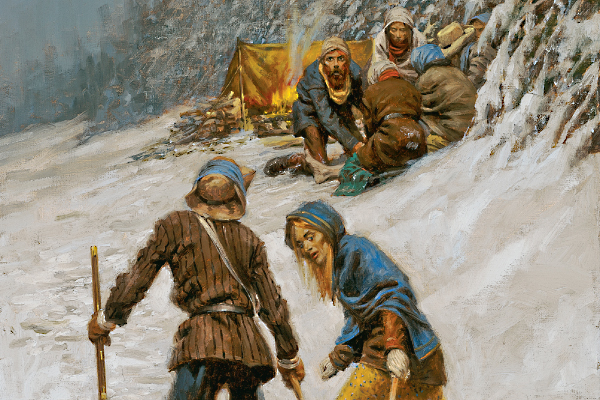
The title poem starts out almost whimsically, mentioning the tale of sailors forced to cannibalism after their ship went down at sea. The poem’s speaker wonders how human meat would taste...The arm, the hip, the liver, the heart. He describes how the captain butchered a sailor, trying to imagine butchering a more familiar meat animal, and mentions another well-known story of the pioneers caught during a blizzard in the Donner Pass. He takes us with him during a reminiscence of being broke and homeless as a teenager, and how he spent the night on the couch of someone who had “wanted to get me into his bed.”
I knocked on his door
And gruff with sleep his voice delivered the news
That another man was there.
But he gave me a blanket and use of the sofa
Just for the remnant of the night.

Next morning all he could find to eat was a box of matzos, Strange, tasteless things for a boy/Just months from a Midwestern farm. I ate them all...

If not for the matzos
I would have eaten the curtains
Over the kitchen sink.
The woodwork with its scabby
Layers of paint.
The worn linoleum on the floor.
But would I have eaten one of the men?
The one who softly snored,
Unaware that I was creeping toward the bed
With a long, sharp knife?

Donner Party preparing dinner